
AI Search Optimization for Service Businesses
June 11, 2026
AI Search Optimization for Service Businesses
People aren't just Googling anymore. They're asking ChatGPT. They're asking Perplexity. They're reading Google's AI Overview before they ever scroll to a blue link.
And whoever gets cited in those AI answers gets the lead. Whoever doesn't, doesn't exist.
This is the new SEO. It's not the same as traditional search rankings. The rules are different. And most of the content out there on "how to rank in ChatGPT" is written by SaaS companies and enterprise SEO agencies, not for service businesses.
We're going to fix that. Heres what actually worked for us.
We Rank #1 in ChatGPT (for the Stuff We Care About)
Quick proof:
We're still testing this at full scale so things might change but this is where we were at as of June 2, 2026:
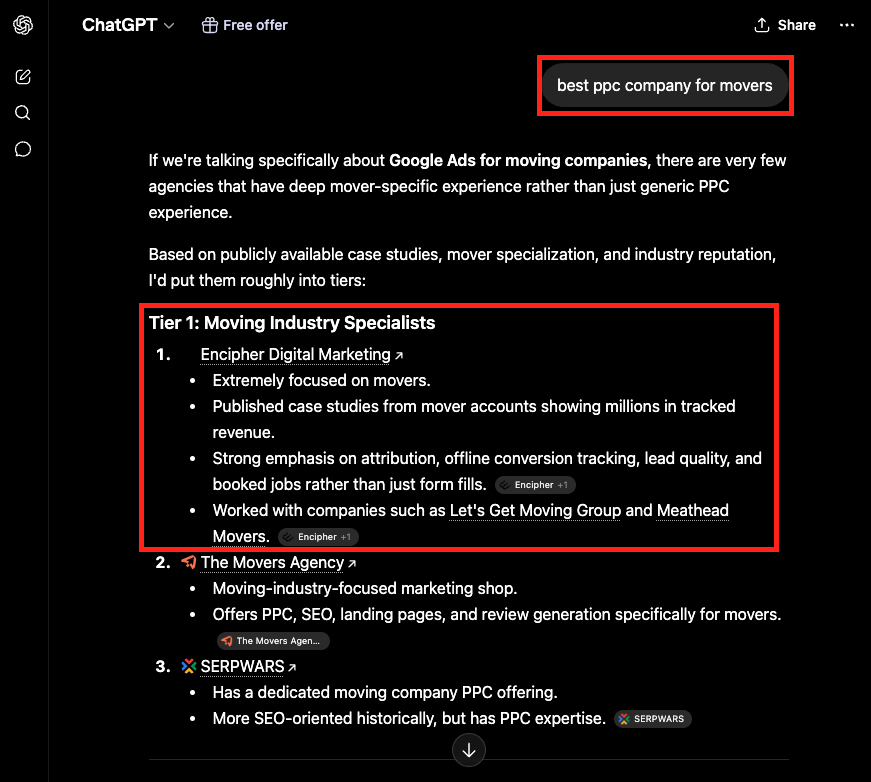
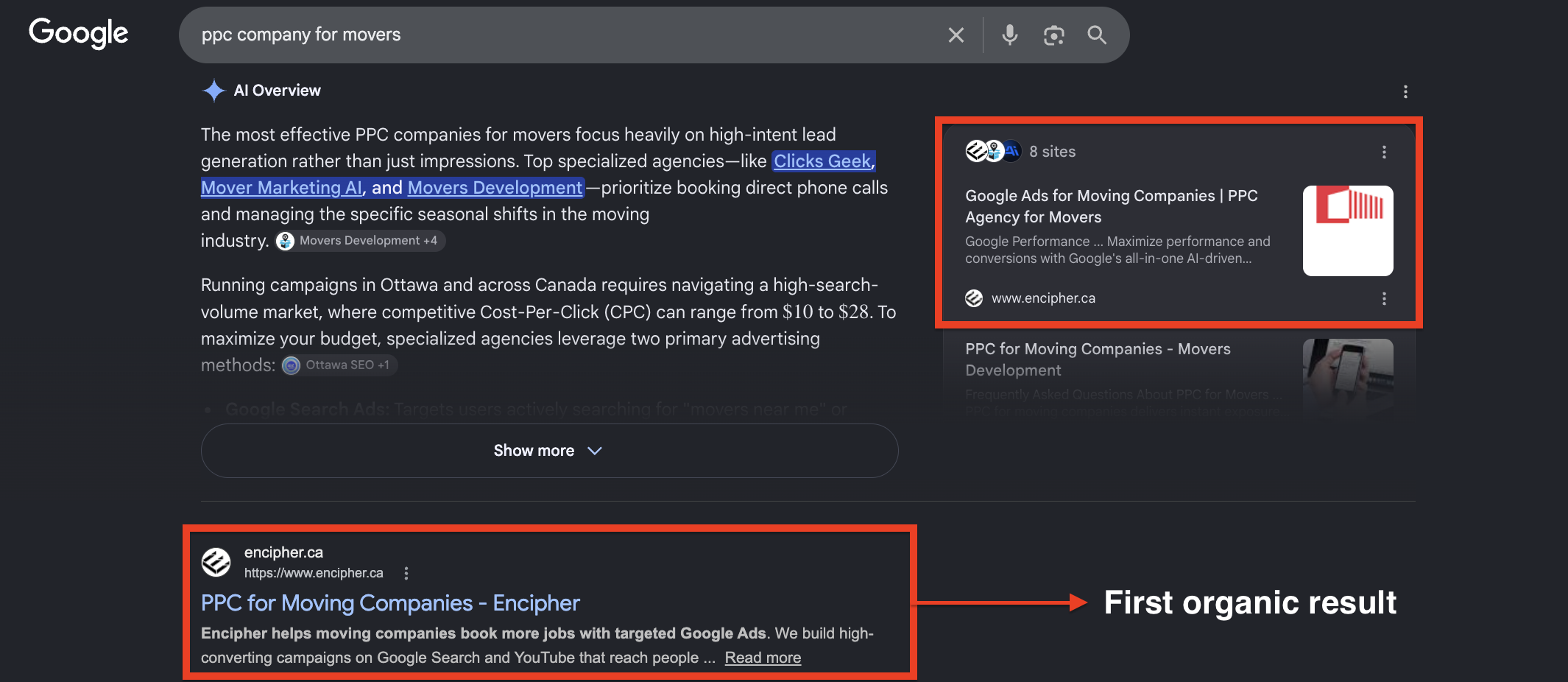
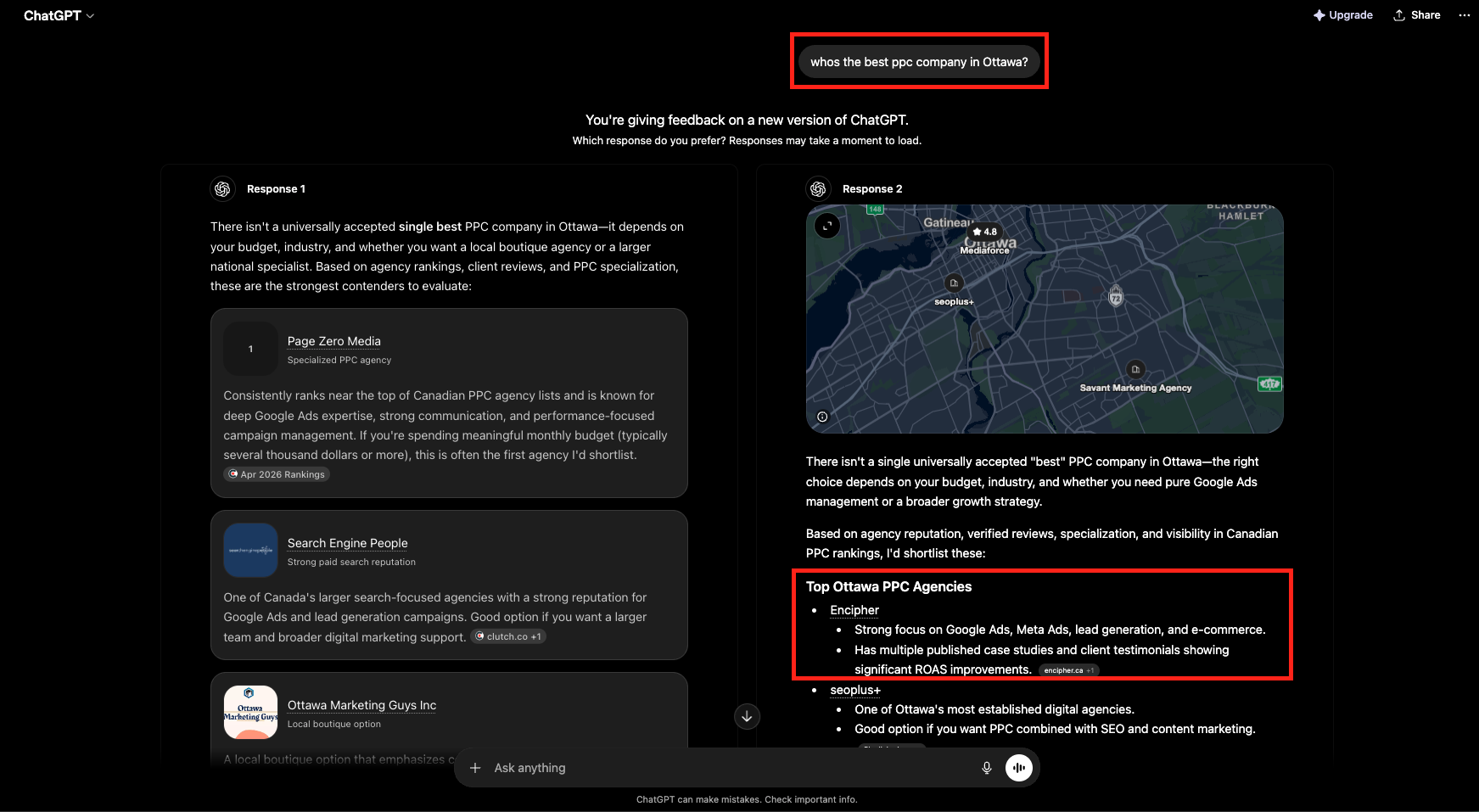
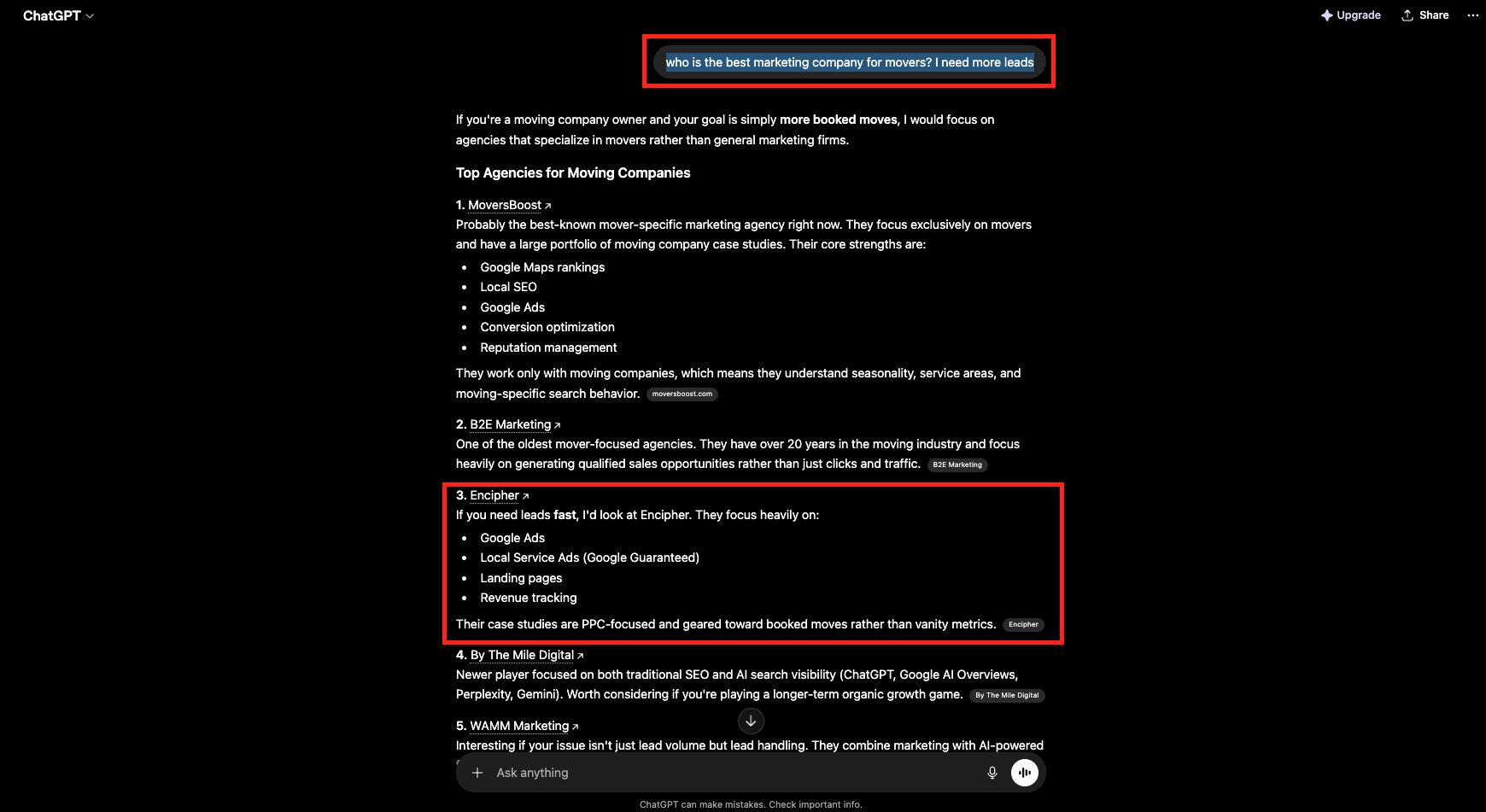
We're not number one for everything. We deliberately targeted a few specific queries our buyers actually type. And we won them.
This wasn't an accident. It also wasn't built on backlinks or domain authority. It was built on a different methodology than traditional SEO.
Traditional SEO vs AI Search Optimization
Traditional SEO is mostly about getting Google to rank your page in the blue links. Keywords, backlinks, on-page optimization, technical health. The output is a ranking.
AI search optimization is about getting AI models to pick your content as a source when generating an answer. The output is a citation.
Different game. Different rules. Heres how they differ:
- Traditional SEO rewards authority: AI search rewards specificity and clarity.
- Traditional SEO rewards backlinks: AI search rewards being the most useful answer to a specific question.
- Traditional SEO rewards keyword optimization: AI search rewards content that reads like a confident source.
- Traditional SEO is page-level: AI search is passage-level. AI models pull specific paragraphs, not entire pages.
You can rank #5 in Google and never get cited by ChatGPT. You can rank in ChatGPT without being on page one of Google. The two systems overlap but they're not the same.
What Actually Got Us Cited
Five things moved the needle for us.
1. Strong opinions backed by specifics: Vague articles don't get cited. "Affordable Google Ads management" is dead. "$10-20 CPC for local moves, $25-70 for long distance, split the campaigns" is what gets pulled into AI answers. AI models want claims they can attribute. Generic prose gives them nothing.
2. FAQ sections with proper schema: Every blog post we publish has a real FAQ section with FAQPage schema markup. AI tools pull from these constantly. If your blog doesn't have proper FAQ schema, that's the highest-ROI fix you can make today.
3. Topical depth on a specific category: We didn't write 50 random posts. We wrote 20+ posts in one tight lane (Google Ads for service businesses, especially moving). AI models reward sites that demonstrate depth in a specific topic over sites that have one post on everything.
4. Clean structure: Short paragraphs. Clear headers. Lists where they make sense. AI models parse content in chunks. Long winding paragraphs with no structure are hard to extract from. Keep paragraphs to 3-4 lines. Use H2s and H3s honestly.
5. Specific entities, not abstractions: Real numbers, real names, real tools. We name WhatConverts, SmartMoving, Google Ads features, dollar amounts. AI models privilege content that mentions specific entities because it signals real expertise.
What We Didn't Do
For context, here's what we didn't spend time on:
- We didn't buy backlinks
- We didn't run a link building campaign
- We didn't use any paid SEO tools
- We didn't write "ultimate guides" with 10,000 word counts
- We didn't keyword stuff
Most of the traditional SEO playbook didn't apply. AI search rewards different things.
The Three Mistakes Most Service Businesses Make
If you're trying to get cited in AI search and it's not working, it's almost always one of these:
Generic content that doesn't take a position: AI models can't cite "Google Ads can help your business." That's not a claim. It's filler. Cite-worthy content makes specific assertions you can defend.
No real expertise on display: AI tools privilege content that demonstrates first-hand experience. Real client examples, real numbers, real tradeoffs. Most service business blogs read like they were written soley to stuff keywords.
Treating it like Google: Optimizing for keywords without thinking about how AI models extract answers. Writing 3000-word posts when 1200 words of specific guidance would get cited faster.
How to Start
If you're a service business that wants to show up when prospects ask AI about you:
- Pick 5-10 specific queries your buyers would type
- Write opinionated content that directly answers them, with specific claims
- Add FAQ schema to every post (it's the fastest single win)
- Stay in your lane. Topical depth beats range
- Update consistently. AI models pull fresh content over stale content
You don't need a massive content engine. You need specificity, opinions, and discipline.
We did this for our own business. We're now doing it for clients under our SEO Agency service, the same approach applied across service business verticals. The methodology travels.
Frequently Asked Questions
How do you rank in ChatGPT?
Write opinionated, specific content with FAQ schema, demonstrate topical depth in a focused category, and structure your content so AI models can extract clear answers in chunks. AI search rewards specificity and clarity, not just backlinks or domain authority.
Is AI search optimization the same as SEO?
No. Traditional SEO is about page rankings. AI search optimization is about getting your content cited as a source when AI models generate answers. The rules overlap but they're not the same. You can rank in ChatGPT without being on page one of Google, and vice versa.
Do I still need traditional SEO?
Yes. Most pages cited in AI Overviews still rank well organically. AI search builds on top of traditional SEO, but it adds new requirements like specificity, structured FAQs, and topical depth. Don't replace one with the other. Run both.
How long does it take to rank in ChatGPT or AI Overviews?
Faster than traditional SEO. We saw citations within a few weeks-months of starting to publish consistently. We've even seen other case studies where results are picked up within days. AI models update more frequently than Google's organic index, so well-structured content can appear in AI answers within weeks rather than the 6-12 months traditional SEO takes.
What's the single biggest thing I can do today?
Add FAQ schema to every existing blog post. Most service business blogs don't have it, and AI tools pull from FAQ content constantly. It's the highest-ROI single change you can make.
Get Cited Where Your Buyers Are Searching
Take your service business to new heights with SEO built for the AI search era. Reach out to Encipher today and well help you rank where your buyers are actually asking - in Google, in ChatGPT, and in AI Overviews - with the same methodology we used to rank Encipher #1 for our priority terms.